

Cell Phone Screen Replacement Wholesale: OEM vs Aftermarket Quality - The Insider's Guide
The $15,000 Lesson Nobody Talks About
Last year, a repair shop owner in Chicago called me at 2 AM his time. He was panicking.
He'd just received his third batch of "OEM quality" iPhone 13 Pro Max screens from a supplier he'd found on Alibaba. The first two batches were perfect—crisp displays, responsive touch, zero complaints. So he went big on the third order: 500 units at $58 each.
Within two weeks, 47 customers came back. The screens looked fine, but customers complained about "weird colors" and "eye strain after 10 minutes." His Yelp rating dropped from 4.7 to 3.4. He had to replace every screen at his own cost.
Total damage:
- 47 screen replacements: $2,726 in parts
- Labor for reinstalls: $1,880
- Refunds for customers who didn't return: $3,200
- Lost future business (estimated): $8,000+
The screens weren't defective in the traditional sense. They were factory rejects that failed PWM flicker testing—screens that pulse at frequencies below the safe threshold, causing eye strain and headaches in sensitive users. His supplier had bought them at 40% discount and relabeled them as "OEM quality."
Here's what kills me: a 30-second test with his phone camera would have caught this before he accepted the shipment.
This guide exists because I've seen this story repeat hundreds of times. After 10+ years sourcing screens from Huaqiangbei—the world's largest electronics market in Shenzhen, China—I've learned that the terms "OEM" and "aftermarket" are almost meaningless. What matters is understanding the actual quality grading system that suppliers use internally, knowing the questions that expose middlemen, and having a testing protocol that catches problems before they become your problem.
If you're a repair shop owner or procurement professional buying screens wholesale, this guide will save you thousands of dollars and countless headaches. But I'll warn you: some of what you're about to read contradicts everything you've been told about phone screen quality.
The Lie of "OEM vs Aftermarket"
Let's start by destroying a myth that costs repair shops money every single day.
When suppliers advertise "OEM quality" screens, most buyers assume this means screens made by the original manufacturer—Samsung Display, LG Display, BOE, or whoever supplies Apple and Samsung. This assumption is almost always wrong.
The term "OEM quality" in the wholesale market is a marketing phrase, not a specification. It means whatever the supplier wants it to mean. I've seen "OEM quality" applied to:
- Genuine factory screens that passed QC
- Genuine factory screens that failed QC and were resold
- Refurbished screens with aftermarket glass
- Fully aftermarket screens with good specs
- Cheap knockoffs with decent packaging
Ask any supplier "which OEM?" and watch them stumble. If they can't immediately name the factory—BOE, Tianma, CSOT, or a specific production line—they're either a middleman who doesn't know, or they're deliberately vague because the answer would hurt their sales.
The insider truth: There is no binary "OEM vs aftermarket" distinction. There's a spectrum of quality grades, and understanding this spectrum is the difference between profitable sourcing and expensive mistakes.
The 6-Tier Quality Grading System
In Huaqiangbei and among factory insiders, screens are graded on a 6-tier system that suppliers rarely discuss with overseas buyers. Understanding this system gives you negotiating power and helps you specify exactly what you need.
Tier 1: 原装屏 (Yuánzhuāng Píng) - Original Factory Screens
These are genuine screens from the original manufacturer (Samsung Display, LG Display, BOE, etc.) that passed all quality control tests. They're identical to what goes into new phones at the factory.
Characteristics:
- Full OEM specifications (brightness, color accuracy, touch sensitivity)
- Original flex cables and IC chips
- Factory warranty documentation available
- Highest price point
Reality check: True Tier 1 screens are rare in the wholesale market. Most come from overproduction, canceled orders, or phones disassembled before sale. If a supplier claims to have unlimited Tier 1 stock at competitive prices, they're lying.
Price indicator: For iPhone 14 Pro Max, expect $120-150+ per unit in bulk.
Tier 2: 原装B品 (Yuánzhuāng B Pǐn) - Factory B-Grade
These are genuine factory screens that failed one or more QC tests but remain functional. Common issues include:
- Minor color calibration variance (within 5% of spec)
- Slight brightness inconsistency across the panel
- Touch sensitivity slightly below spec
- Cosmetic imperfections invisible after installation
Characteristics:
- Same manufacturer as Tier 1
- 90-95% of original performance
- Often sold as "OEM quality" without disclosure
- Significantly lower price than Tier 1
Reality check: This is where most "OEM quality" screens actually come from. They're not bad screens—many perform excellently for years. The problem is when suppliers sell them at Tier 1 prices or mix them with Tier 1 stock.
Price indicator: For iPhone 14 Pro Max, expect $80-110 per unit in bulk.
Tier 3: 后压屏 (Hòu Yā Píng) - Refurbished OEM Display
This is where it gets interesting. 后压屏 literally means "rear-pressed screen"—an OEM display panel with the original cracked glass removed and new glass laminated on top.
The process:
- Collect broken screens with intact display panels
- Separate the glass from the OLED/LCD using specialized equipment
- Clean and test the display panel
- Laminate new glass (aftermarket) onto the original display
- Replace damaged flex cables if needed
Characteristics:
- Original display panel (the expensive part)
- Aftermarket glass (the cheap part)
- Quality depends heavily on the refurbishment facility
- Can be nearly indistinguishable from Tier 1 if done well
Reality check: High-quality 后压屏 from reputable refurbishers is often the best value in the market. The display—which determines color accuracy, brightness, and viewing angles—is genuine OEM. The glass is new. The main risk is poor lamination causing bubbles or separation over time.
Price indicator: For iPhone 14 Pro Max, expect $60-85 per unit in bulk.
Tier 4: 国产软屏 (Guóchǎn Ruǎn Píng) - Domestic Soft OLED
"Soft OLED" refers to flexible OLED panels that can bend slightly—the same technology used in original iPhone screens. Chinese manufacturers like BOE, Visionox, and Tianma now produce soft OLED panels that approach OEM quality.
Characteristics:
- Flexible OLED technology (same as original)
- Chinese-manufactured display panel
- Quality varies significantly by manufacturer
- Best aftermarket option for OLED phones
Reality check: Top-tier domestic soft OLED (especially from BOE) can be difficult to distinguish from OEM in normal use. The technology has improved dramatically since 2020. However, there's huge variance—a cheap soft OLED from an unknown manufacturer is nothing like a premium BOE panel.
Price indicator: For iPhone 14 Pro Max, expect $45-70 per unit in bulk (varies widely by manufacturer).
Tier 5: 国产硬屏 (Guóchǎn Yìng Píng) - Domestic Hard OLED
"Hard OLED" uses rigid OLED panels that don't flex. They're cheaper to manufacture but have limitations.
Characteristics:
- Rigid OLED panel (doesn't flex)
- Thicker than soft OLED
- May not fit perfectly in all phone frames
- Lower color accuracy and brightness than soft OLED
- Significantly cheaper
Reality check: Hard OLED gets a bad reputation, but it has its place. For budget repairs where customers prioritize price over perfection, hard OLED delivers acceptable quality at 30-40% lower cost than soft OLED. The key is setting customer expectations correctly.
Price indicator: For iPhone 14 Pro Max, expect $30-45 per unit in bulk.
Tier 6: LCD替代屏 (LCD Tìdài Píng) - LCD Replacement
For phones originally equipped with OLED, some suppliers offer LCD replacements. These are fundamentally different technology.
Characteristics:
- LCD technology instead of OLED
- No true blacks (backlight always on)
- Lower contrast ratio
- Thicker panel
- Much cheaper
Reality check: LCD replacements for OLED phones are controversial. Some repair shops refuse to use them; others offer them as a budget option with full disclosure. The quality difference is immediately visible to anyone who knows what to look for.
Price indicator: For iPhone 14 Pro Max, expect $20-30 per unit in bulk.
The Hidden Quality Variables
Understanding the 6-tier system is just the beginning. Within each tier, quality varies based on factors suppliers rarely discuss.
PWM Frequency: The Silent Killer
PWM (Pulse Width Modulation) is how screens control brightness. Instead of reducing power continuously, screens flicker on and off rapidly. At high frequencies (above 240Hz), this is invisible and harmless. At low frequencies, it causes eye strain, headaches, and even nausea in sensitive users.
The problem: Factory reject screens often fail PWM testing. They work fine, look fine, but flicker at 120Hz or lower—half the safe threshold. Suppliers buy these rejects cheap and sell them as "OEM quality."
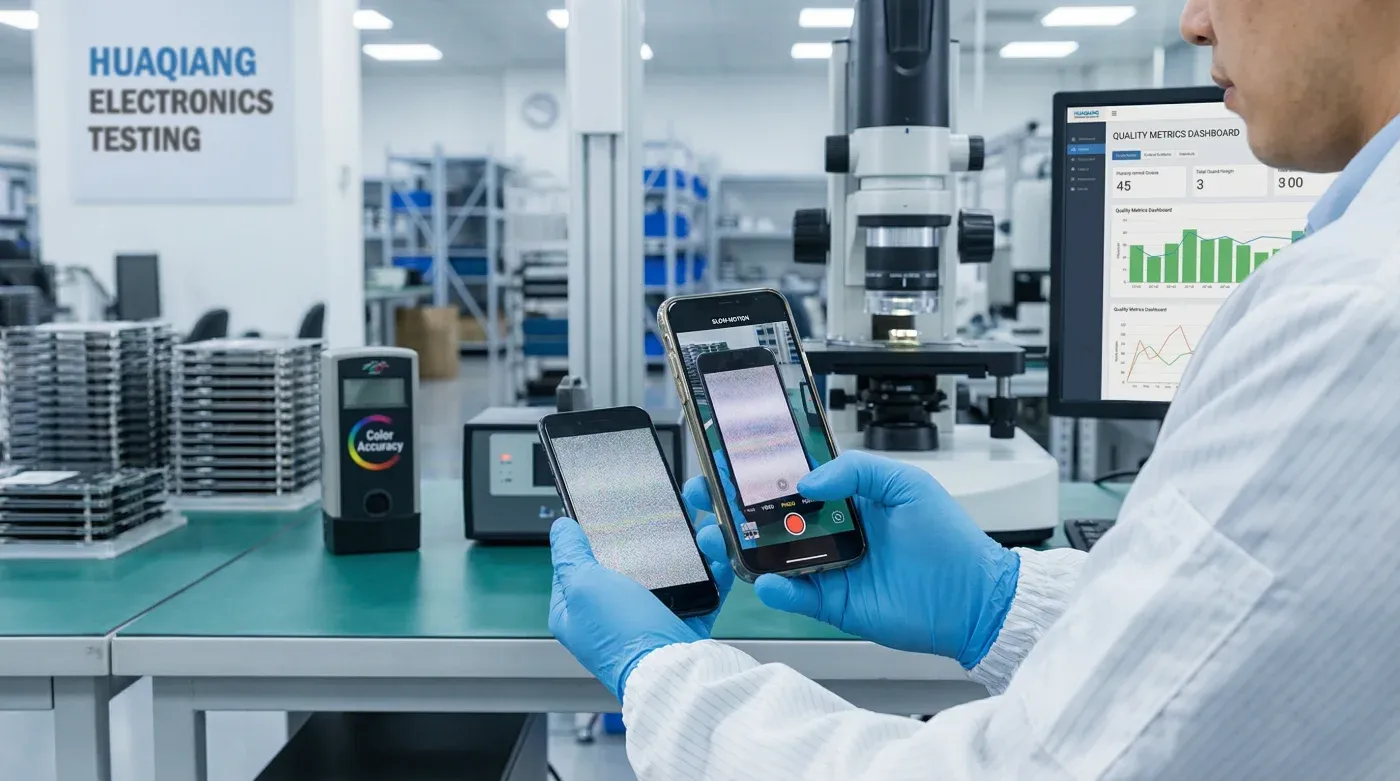
The test: Open your phone camera in slow-motion mode (240fps). Point it at the screen set to 25% brightness. If you see visible flickering bands, the PWM frequency is dangerously low. Reject the batch.
Insider tip: Ask suppliers directly: "这批屏幕的PWM频率是多少?有没有检测报告?" (What's the PWM frequency of this batch? Do you have test reports?) If they don't understand the question, they don't understand quality.
Color Calibration: The Invisible Difference
Two screens can both be "Tier 3 后压屏" but have completely different color accuracy. Factory calibration data is often lost during refurbishment, and cheap refurbishers don't recalibrate.
The test: Display a pure white screen and a pure gray screen side by side with a known-good screen. Look for:
- Pink or green tint in whites
- Uneven brightness across the panel
- Color shift at viewing angles
Insider tip: Premium refurbishers recalibrate every screen. Ask for calibration documentation. If they can't provide it, assume the screens aren't calibrated.
Touch IC Quality: The Delayed Failure
The touch IC (integrated circuit) controls touch sensitivity. Aftermarket touch ICs are cheaper but have higher failure rates—often failing 3-6 months after installation, long after your warranty period.
The problem: You can't test touch IC longevity on arrival. By the time screens start failing, you've installed hundreds.
The solution: Track failure rates by supplier and batch. If a supplier's screens start failing at 3-4 months consistently, their touch ICs are substandard. Switch suppliers immediately.
Insider tip: Ask suppliers: "触摸IC是原装还是国产?" (Is the touch IC original or domestic?) Original ICs cost more but have dramatically lower failure rates.
Supplier Verification: Separating Factories from Middlemen
Here's an uncomfortable truth: most "suppliers" you find on Alibaba, Made-in-China, or through Google searches are not factories. They're trading companies—middlemen who buy from factories and add their markup.
Trading companies aren't inherently bad. Good ones provide valuable services: quality control, consolidation, English communication, payment protection. Bad ones add cost without adding value, and they can't guarantee consistency because they're buying from whoever offers the best price that week.
Red Flags That Indicate Middlemen
1. They respond to WeChat at 2 AM China time
Factories have business hours. If your "factory contact" is answering messages at 2 AM Beijing time, they're a salesperson working your timezone—almost certainly a trading company.
2. They can't answer technical questions immediately
Ask: "这批货是哪个厂的?用的什么基板?" (Which factory is this batch from? What substrate are they using?)
A factory rep knows instantly. A middleman says "let me check" and comes back hours later with a vague answer.
3. Their prices fluctuate weekly
Factories have stable pricing based on production costs. Trading companies' prices fluctuate based on their current supplier relationships. If quotes vary more than 5% week to week, you're dealing with a middleman.
4. They offer every brand and model
No factory makes screens for every phone model. If a supplier offers iPhone, Samsung, Xiaomi, Oppo, and Huawei screens all at competitive prices, they're aggregating from multiple sources.
5. They can't provide factory audit documentation
Real factories have ISO certifications, production line photos, and audit reports. Ask for them. "能提供工厂审核报告吗?" (Can you provide factory audit reports?)
Questions That Expose Quality
Beyond identifying middlemen, these questions reveal whether a supplier actually understands quality:
"这批屏幕的良品率是多少?" (What's the yield rate of this batch?)
- Good answer: Specific percentage, e.g., "98.5% pass rate"
- Bad answer: "Very high quality" or "All good"
"有没有老化测试报告?" (Do you have aging test reports?)
- Good answer: Yes, with specific test duration and conditions
- Bad answer: "What's that?" or "Not necessary"
"退货率一般是多少?" (What's your typical return rate?)
- Good answer: Specific percentage with explanation, e.g., "0.8% for soft OLED, 1.5% for hard OLED"
- Bad answer: "Very low" or "Almost zero"
"能不能先发样品测试?" (Can you send samples for testing first?)
- Good answer: Yes, with clear sample pricing and shipping terms
- Bad answer: Reluctance or excuses
The Quality Testing Protocol
Before committing to any bulk order, implement this testing protocol. It takes about 15 minutes per batch and has saved our clients hundreds of thousands of dollars.
Pre-Order Testing (Before You Commit)
Step 1: Request Samples (3-5 units)
Never commit to bulk orders without testing samples first. Yes, samples cost money. That cost is insurance against a $15,000 mistake.
Step 2: The Black Room Test
- Take samples to a completely dark room.
- Display pure black (use darkblackscreen.com).
- Set brightness to 100%.
- Any visible glow = LCD mislabeled as OLED, or OLED with backlight bleed.
- Reject if glow is visible.
Step 3: The Slow-Mo Flicker Test
- Open phone camera in slow-motion mode (240fps).
- Point at screen displaying white at 25% brightness.
- Visible flickering bands = dangerous PWM frequency.
- Reject if flickering is visible.
Step 4: The Color Accuracy Test
- Display pure white, pure red, pure green, pure blue.
- Compare side-by-side with known-good OEM screen.
- Look for tint, saturation differences, brightness variance.
- Document any differences for negotiation.
Step 5: The Touch Sensitivity Test
- Open a drawing app.
- Draw diagonal lines corner to corner rapidly.
- Lines should be smooth, not jagged or broken.
- Test all four corners and center.
- Any dead zones = reject.
Batch Arrival Inspection
When your bulk order arrives, don't just count boxes. Implement random sampling:
5% Random Sample Rule
- For orders under 100 units: test 5 random screens.
- For orders 100-500 units: test 10 random screens.
- For orders 500+ units: test 25 random screens.
The Consistency Check
- All sampled screens should perform identically.
- Variance in color, brightness, or touch sensitivity indicates 混货 (mixed batches).
- Mixed batches mean your supplier is aggregating from multiple sources—quality will be inconsistent.
Documentation Protocol
- Photograph each tested screen with serial number visible.
- Record test results in spreadsheet.
- Keep records for warranty claims and supplier negotiations.
Long-Term Quality Tracking
The real test of screen quality happens months after installation. Implement tracking:
Track by Supplier and Batch
- Record which supplier and batch number for every installation.
- When customers return with issues, log the supplier/batch.
- Calculate failure rate by supplier over 3, 6, and 12 months.
The 2% Rule
- Industry average RMA rate: 3-5%.
- Good supplier RMA rate: 1-2%.
- Excellent supplier RMA rate: <1%.
- If any supplier exceeds 3%, investigate or switch.
The 90-Day Cliff
- Quality issues from bad touch ICs typically appear at 60-120 days.
- If you see a spike in failures at this timeframe, the batch had IC problems.
- Document and use for supplier negotiations or claims.
The Pricing Reality: Why Cheap Screens Cost More
Let me share some math that changed how I think about screen sourcing.
The True Cost Calculation
Scenario A: "Cheap" Screens
- Purchase price: $35/unit
- Order quantity: 200 units
- Total cost: $7,000
- RMA rate: 4%
- Failed units: 8
- Replacement cost: $35 × 8 = $280
- Labor for reinstalls: $40 × 8 = $320
- Customer refunds (50% of failures): $80 × 4 = $320
- Lost customers (estimated): 4 × $200 lifetime value = $800
- True total cost: $8,720 ($43.60/unit)
Scenario B: "Expensive" Screens
- Purchase price: $55/unit
- Order quantity: 200 units
- Total cost: $11,000
- RMA rate: 0.8%
- Failed units: 1.6 (round to 2)
- Replacement cost: $55 × 2 = $110
- Labor for reinstalls: $40 × 2 = $80
- Customer refunds: $80 × 1 = $80
- Lost customers: 1 × $200 = $200
- True total cost: $11,470 ($57.35/unit)
The "cheap" screens cost $43.60/unit after accounting for failures. The "expensive" screens cost $57.35/unit. The difference is $13.75/unit—not $20.
But here's what the math doesn't capture: reputation damage. One viral negative review costs more than a hundred screen replacements. The shop owner in Chicago didn't just lose $15,000 in direct costs—his Yelp rating dropped 1.3 stars, and he estimates he lost $50,000+ in business over the following year.
Volume Pricing Strategies
If you're buying in volume, use these strategies to get better pricing without sacrificing quality:
1. Commit to Consistent Orders
Suppliers offer better prices for predictable, recurring orders than for one-time bulk purchases. A commitment to 100 units/month for 12 months gets better pricing than a single 1,200-unit order.
2. Negotiate Payment Terms, Not Just Price
Instead of pushing for lower unit prices, negotiate:
- 30-day payment terms instead of upfront payment
- Free shipping on orders above threshold
- Extended warranty periods
- Free replacements for DOA units
3. Bundle Models
If you repair multiple phone models, bundle orders with one supplier. "I need 100 iPhone 13 screens and 50 Samsung S22 screens" gets better pricing than two separate orders.
4. Time Your Orders
Screen prices fluctuate seasonally:
- Highest: September-November (new iPhone launch, holiday prep)
- Lowest: February-March (post-holiday slowdown)
- Plan major orders for low season when possible
The Monday Morning Action Plan
You've read 4,000 words about screen quality. Here's what to do with this knowledge starting tomorrow.
Immediate Actions (This Week)
1. Test Your Current Inventory
Pull 5 random screens from your current stock. Run the slow-mo flicker test. If any show visible flickering, you now know why some customers complain about eye strain. Consider switching suppliers.
2. Audit Your Supplier
Send this message to your current supplier:
"我想了解一下你们屏幕的具体情况。这批货是哪个厂生产的?PWM频率是多少?有没有检测报告可以提供?"
(I'd like to understand more about your screens. Which factory produces this batch? What's the PWM frequency? Can you provide test reports?)
If they can't answer clearly within 24 hours, start looking for alternatives.
3. Start Tracking
Create a simple spreadsheet:
- Column A: Customer name
- Column B: Phone model
- Column C: Screen supplier
- Column D: Batch number
- Column E: Install date
- Column F: Return date (if applicable)
- Column G: Issue description
Track every installation. In 90 days, you'll have data to make informed supplier decisions.
Short-Term Actions (This Month)
4. Request Samples from 2-3 New Suppliers
Don't put all eggs in one basket. Identify 2-3 potential suppliers and request samples. Test them using the protocol in this guide. Compare results.
5. Negotiate Better Terms
Armed with knowledge from this guide, renegotiate with your current supplier:
- Request batch test reports
- Ask for extended warranty on touch IC failures
- Negotiate replacement terms for quality issues
6. Set Quality Standards
Define your minimum acceptable quality:
- Maximum acceptable RMA rate: ____%
- Required PWM frequency: ____Hz minimum
- Required documentation: ____
Communicate these standards to suppliers. Suppliers who can't meet them aren't worth your business.
Long-Term Strategy (This Quarter)
7. Build Supplier Relationships
The best pricing and quality come from long-term relationships. Once you find a good supplier:
- Pay on time, every time
- Provide feedback on quality issues professionally
- Give them predictable order volumes
- Visit their facility if possible
8. Consider Direct Factory Relationships
If your volume justifies it (500+ units/month), consider establishing direct factory relationships. This requires:
- Chinese language capability (or a trusted partner)
- Ability to handle international shipping and customs
- Higher minimum order quantities
- But: 20-30% cost savings and better quality control
Final Thoughts: Quality Is a System, Not a Purchase
The repair shops that consistently profit from screen replacements don't just buy good screens—they build systems for ensuring quality. They test every batch. They track every installation. They hold suppliers accountable. They're willing to pay more for reliability.
The shops that struggle are always chasing the cheapest price, always surprised by quality issues, always dealing with angry customers and negative reviews.
The difference isn't luck. It's knowledge and discipline.
You now have the knowledge. The discipline is up to you.